Wilderness Crossing Lawsuit Update!

ORANGE COUNTY ADMITS ERROR IN
WILDERNESS CROSSING REZONING

In unanimous vote, Board of Supervisors finds that zoning district violated Virginia Code, casting 2023 Wilderness Crossing rezoning in doubt


(Orange, Va.) — In a special meeting yesterday, the Orange County Board of Supervisors unanimously passed a resolution acknowledging a misstep in creation of the Planned Development-Mixed Use (PDM) Zoning District. The resolution found that the PDM Zoning District, which paved the way for the Wilderness Crossing mega-
development rezoning in 2023, violated Virginia State Code. The PDM Zoning District was adopted in July 2018 by a previous Board of Supervisors.


“We applaud the county’s decision to reexamine the creation of the PDM Zoning District and willingness to acknowledge an error was made,” remarked American Battlefield Trust president David Duncan. “While we understand the need for the county to proceed in a methodical manner, today’s decision points to only one final
result: invalidation of the Wilderness Crossing rezoning.”


In a press statement issued following the vote, the Board of Supervisors stated: “After reviewing the available legislative record and applicable law, the Board acknowledged that ZTA 18-05 was not initiated in the manner required by Virginia Code § 15.2-2286(A)(7). The Board believes it is important to address that procedural issue candidly and to respect the requirements governing County land use decisions.”


The board’s finding mirrors part of the factual basis for the legal challenge brought by the American Battlefield Trust, Friends of the Wilderness Battlefield (FOWB) and the Central Virginia Battlefields Trust (CVBT), with the support of nearby residents, against the Wilderness Crossing Rezoning. The defective initiation of the PDM Zoning District is one of several grounds advanced in their lawsuit to set aside the rezoning as illegal.


A judicial finding of defective initiation, agreeing with the County’s about-face on the PDM Zoning District, should invalidate the Wilderness Crossing development, which envisions construction of up to 5,000 residential units and more than 800 acres for commercial and industrial uses, including data centers, at the gateway of the
Wilderness Battlefield.


The decision marks a dramatic reversal from April 2023, when the Orange County Board of Supervisors approved the massive Wilderness Crossing rezoning by a near-unanimous vote. In doing so, the Board rejected requests from the preservation community, the National Park Service and others to study the effects of the
rezoning, the largest in county history, on the Wilderness Battlefield. The Trust, CVBT, FOWB, and local homeowners filed suit the following month, alleging that the approval process violated Virginia laws that limit the County’s zoning authority, require deliberative and transparent decision-making, and ensure equal taxation of land. Although the case has not yet gone to trial, a circuit court judge has repeatedly rejected attempts to dismiss the challenge.


“The County’s decision reflects its willingness to listen to the community and to follow the rule of law,” said Robert Lookabill, president of Friends of Wilderness Battlefield. “A project with this unprecedented scale, demands on local infrastructure and threats to our area’s natural resources has no place near the Wilderness Battlefield.”


“Once this landscape is lost to development, it is lost forever,” said Tom Van Winkle, president of the Central Virginia Battlefields Trust. “In taking a fresh look at the PDM Zoning District approval, the County has made the right decision for local residents and the historic battlefield. We hope the board’s decision signals that this controversy is nearing its end.”


The Wilderness Battlefield was named one of the country’s 11 Most Endangered Historic Places by the National Trust for Historic Preservation in 2024. The area that was rezoned for development includes hundreds of acres identified by the National Park Service as within the historic boundaries of the Wilderness Battlefield. The National Parks Conservation Association, National Trust for Historic Preservation, the
Coalition to Protect America’s National Parks and the Piedmont Environmental Council have filed briefs in the case, supporting the challenge and detailing both the serious threat to sacred ground posed by the Wilderness Crossing development and the extraordinary investments that have been made by the groups and others to preserve the Wilderness Battlefield.


The news comes on the heels of another major legal victory for battlefield preservation in Northern Virginia, where the Trust and local residents defeated three fast-tracked rezonings that paved the way towards erecting a massive data center complex next to Manassas National Battlefield Park. In March, a unanimous Virginia Court of Appeals panel ruled that Prince William County had acted unlawfully in approving the Prince William Digital Gateway project, prompting the County to abandon its defense of the rezonings. Ultimately, the County and both data center developers opted not to continue the lawsuit. These striking reversals for projects threatening historic and cultural resources and communities are mirrored by shifts in public opinion; a recent
poll conducted by The Washington Post and George Mason University found that only 33% of Virginians would support a data center being built in their community, down from 69% as recently as 2023.


###


About the American Battlefield Trust: The American Battlefield Trust is dedicated to preserving America’s hallowed battlegrounds and educating the public about what happened there and why it matters today. The Trust enjoys the support of more than 500,000 members and supporters from all 50 states and around the world. The organization has protected 63,000 acres associated with the Revolutionary War, War of 1812 and Civil War across more than 160 sites in 25 states, including more than 500 acres at The Wilderness. Learn more at www.battlefields.org.


About the Central Virginia Battlefields Trust (CVBT): The Central Virginia Battlefields Trust is a nonprofit organization that preserves battlefield land associated with the four major Civil War campaigns: Fredericksburg, Chancellorsville, Mine Run, and the Overland Campaign, including the Wilderness and Spotsylvania. CVBT celebrated its 30th anniversary in the battlefield preservation business earlier this year. Learn more at www.cvbt.org.


About the Friends of Wilderness Battlefield (FOWB): The purpose of the Friends of Wilderness Battlefield is to assist like-minded historic preservation organizations in their efforts to preserve the Wilderness Battlefields in Spotsylvania and Orange Counties. The Friends provide advocacy, educational programs, and service projects for the battlefield. Learn more at www.fowb.org.
Help Save Two Acres of May 2, 1863, Chancellorsville Flank Attack Land!

Dear Preservation Partner,

On the evening of May 1, 1863, Lee and Jackson began discussing a bold plan for how to defeat the Army of the Potomac, now gathering at Chancellorsville. Soon, Lee’s cavalry chief, “Jeb” Stuart, brought the startling news that the Union right flank was exposed. The conversation shifted to how best to reach the vulnerable position. Jackson consulted with staff officers and soldiers from the area and sent his topographical engineer to scout western roads.

  Before dawn, Lee and Jackson studied a rough map and chose one of the boldest gambles in American military history. Jackson would lead over 28,000 men by back roads toward the Union right, while Lee used 15,000 infantry along a three-mile front to hold Hooker’s attention. Once Jackson was in position, his attack would leave the Confederate army dangerously divided into three parts. It was a risk with high stakes.

  On the morning of May 2, Jackson led his column down Furnace Road. When Union scouts at Hazel Grove spotted the march, Federal artillery fired on his men and alerted Hooker. Hooker correctly saw the move as a threat to his right and warned Maj. Gen. Oliver O. Howard to watch for an attack from the west against his XI Corps. But as the morning passed, Hooker decided Lee was retreating and ordered the III Corps to harass the rear of Jackson’s marching column.

  Maj. Gen. Daniel E. Sickles advanced from Hazel Grove toward Catharine Furnace. By mid-afternoon, his troops had overwhelmed Jackson’s rearguard near an unfinished railroad cut and almost captured a whole Georgia regiment. The fighting drew away about 20,000 Union soldiers, leaving Howard’s XI Corps isolated on the right.

Meanwhile, for much of their march, Jackson’s column moved along narrow, uncharted trails. By twice turning away from the Union line, “Stonewall” strengthened Hooker’s belief that the Confederates were retreating. His force then slipped through the Wilderness toward Howard’s unsuspecting troops.

Jackson continued north to the Orange Turnpike, beyond the Union right. Around 3 p.m., his men completed the 12-mile march and formed a battle line nearly two miles long with 11 of his 15 brigades in position for the attack.

Though some Federal soldiers warned that Jackson’s force was nearby, XI Corps headquarters dismissed the reports. With little cavalry on hand to scout the Wilderness, only two small regiments and half a New York battery faced west toward Jackson’s corps.

  Late in the afternoon of May 2, 1863, turkeys, rabbits, deer, and other wild game suddenly burst from the woods west of this clearing, amusing XI Corps soldiers as they prepared camp and cooked rations. Moments later, gray-clad soldiers emerged behind them: the first wave of Jackson’s 28,000-man flank attack was in motion. As one Massachusetts soldier recalled, “Along the road it was pandemonium . . . and on the side of the road it was chaos.”

Howard’s men fought bravely, forming three more lines, but their position could not hold. Confederate assaults overran each stand and drove the XI Corps from the field. The rout had begun, and Jackson had reached the height of his success, fame, and military glory.

It was only two brief years after the founding of the Central Virginia Battlefields Trust (CVBT) when a piece of property became available near where Jackson’s famous Chancellorsville flank attack first made contact with XI Corps troops on May 2, 1863. This tract, consisting of just over 5 acres, had been slated for yet another modern building along a rapidly developing Route 3.

Fortunately, CVBT secured the property before any clearing or construction began. When we asked for donations, our preservation partners responded, helping us save the tract and stop its development. In 1999, the parcel was transferred to the National Park Service, adding more than five historic acres to Fredericksburg-Spotsylvania National Military Park. Thanks to generous donors like you, visitors can now look across this part of the battlefield unobstructed and better imagine the events that unfolded there in May 1863.

Since that first acquisition along the route of Jackson’s Chancellorsville flank attack, CVBT’s supporters have helped us acquire or assist with ten other tracts totaling over 110 acres. All ten of the most recent acquisitions have been on the south side of Route 3. These purchases have allowed us to piece together an amazing amount of road-fronting acreage over the years.

It only seems fitting that in this, CVBT’s 30th Anniversary year, yet another flank attack property, nearly across the road from the original one purchased in 1998, would become available to add to the ever-growing list of what is becoming a battlefield preservation corridor along modern Route 3.  

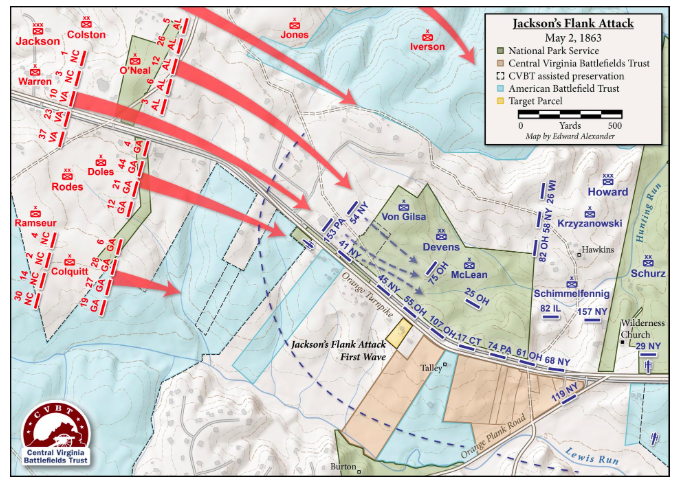
  This new two-acre tract, which we call Jackson’s Flank Attack—First Wave, is a vital connector parcel. It will help link the many properties CVBT has preserved to the east with land saved by our friends at the American Battlefield Trust to the west. Thanks to generous supporters across the United States, the nearly 30-year dream of preserving the Chancellorsville flank attack route is becoming a reality—one parcel at a time. Thank you!

We need to raise $125,000 to preserve this property. Will you help us save it?

This land marks the position where some XI Corps troops of the Army of the Potomac first encountered the opening wave of Jackson’s flank attack.

  Writing about the early fighting near this site, Union Col. John C. Lee of the 55th Ohio noted: “Soon the men and officers on our right flank began to give way, and to retreat to the eastward in our rear in a disorganized form. The battery that had run up so close to us began to deliver grape and canister right along the road and was very destructive to our line which occupied the south side of the road, with a slight barricade made out of fence rails, with earth thrown on them. Our line still fronted to the south.” Col. Lee rode to Brig. Gen. Charles Devens and Brig. Gen. Nathaniel McLean who commanded the division and brigade respectively and asked if he should change his front to face west to meet Jackson’s large force. Devens did not answer, and McLean told Lee, “Not yet.” Lee rode back to his unit who had moved to the north side of the road due to the “raking fire” from the Confederates and rode back to Devens and McLean to report the rapidly deteriorating situation.

  Receiving no instructions, only a dismissive wave, Lee rode back. “The enemy were slowly approaching with constant firing, and we were unable to get off a shot,” Lee explained. At his return, Col. Lee’s horse was shot from under him. Stunned and bruised, he joined the retreat. With others, Lee rallied for a defensive stand near Dowdall’s Tavern. However, Jackson’s force outflanked and overwhelmed their attempt to hold, and Col. Lee and the others had to continue to retreat eastward.  

Jackson’s bold maneuver made history. Its success helped secure the Confederate victory at Chancellorsville and shaped later decisions by both armies that influenced the war’s outcome. Military leaders still study the flank attack today.

  Together, we can carry CVBT’s 30-year legacy forward by preserving this important parcel. Please consider supporting this campaign so future generations can experience this battlefield landscape and understand the history that still resonates so strongly today.

Sincerely, 

Tom Van Winkle

CVBT President

5.2 more acres at Gettysburg are within reach

Two properties totaling 5.2 acres at Gettysburg have become available for preservation.

These aren’t isolated parcels. They border land that you and other American Battlefield Trust supporters have already helped preserve.

Saving them would strengthen and expand that protected battlefield landscape. But if we miss this opportunity, they could be lost.

Both properties are zoned for residential and commercial development. New offices, apartments, or other construction could permanently erase an important piece of Gettysburg’s story.

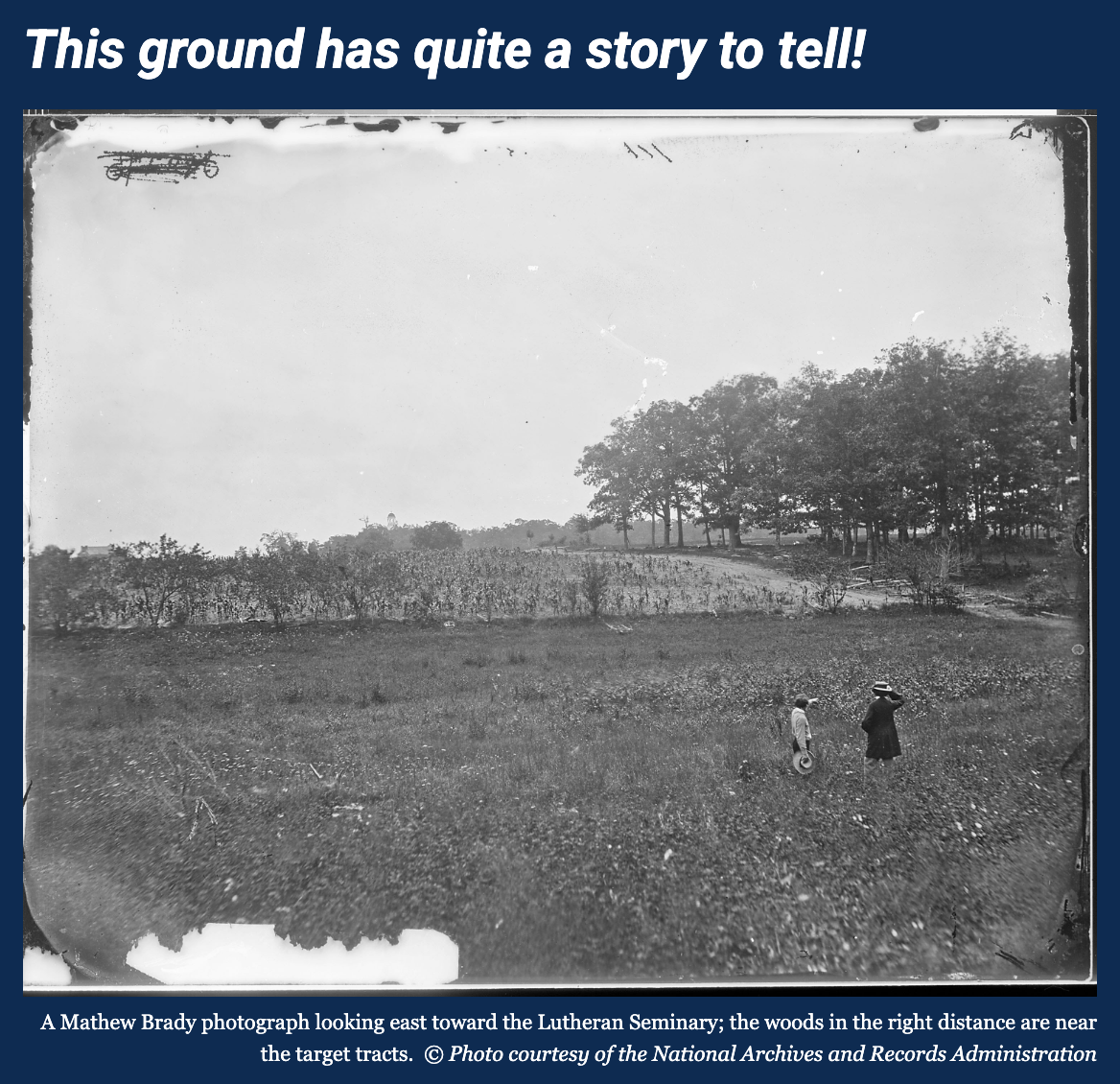
This ground has quite a story to tell!

On July 1, 1863, Union and Confederate troops moved across and around these properties as the Battle of Gettysburg erupted. Buford’s cavalry passed over this ground. The famed Iron Brigade crossed here on its way toward Willoughby’s Run. Union soldiers later retreated across it under Confederate pressure.

Learn More

You’ve already helped preserve part of this remarkable landscape. Now we have an opportunity to protect another 5.2 acres.

The properties are valued at $1.765 million, but anticipated government preservation grants and support from a private foundation mean we need to raise only the final $320,000.

That means every $1 you give today can be matched $5.50-to-$1.

Give to Preserve Five Acres at Gettysburg

This is Gettysburg. Once this ground is developed, we can never get it back.

Thank you for standing with us before — and for considering another gift today.

'Til the battle is won,

David N. Duncan
President
American Battlefield Trust

Please help us build on that legacy while every dollar you give can have 5.5 times the impact today.

Donate Now to Preserve Gettysburg

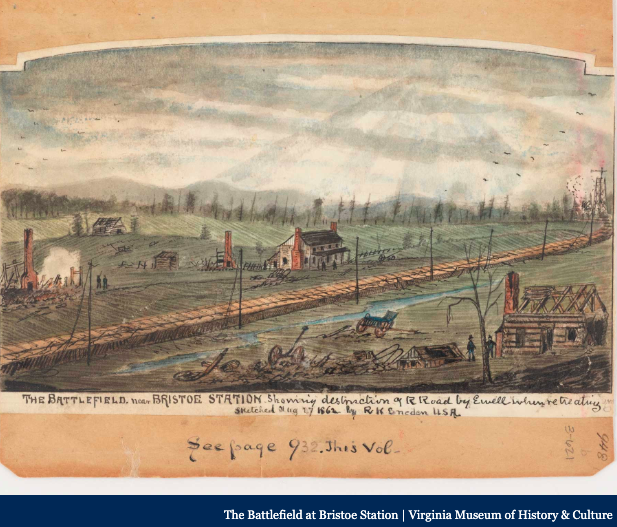
155 acres at risk in Cold Harbor & Bristoe Station

Two significant and highly vulnerable tracts are up for grabs in Bristoe Station and Cold Harbor, Virginia.

While this hallowed ground is priced at a staggering $8 million, thanks to the efforts of preservation-minded supporters and the generosity of our partners, we have the opportunity to secure these tracts for just $328,000.

An astonishing $27-to-$1 match!

The devastating battles that occurred on these tracts were pivotal to the Civil War. 
$100 = $2,700 of impact preserving this hallowed ground.

Give Now

These tracts spanning 152 acres in Bristoe Station and three vulnerable acres in Cold Harbor would add substantially to the preserved land on the Union side of the battle lines.

The battles fought here saw some of the worst casualties of the Civil War — and were regretted for life by both Generals Lee and Grant. 

  • At Bristoe Station, General A.P. Hill ordered an assault on Union troops that led to 1,300 casualties of his own men in just a short battle.

  • At Cold Harbor, a similar story played out — like a larger Bristoe Station, but in reverse. It is often referred to as one of the most lopsided slaughters of the Civil War, as Grant's failed frontal assault led to massive casualties. 

These tracts have been under the threat of development for years and have already been zoned for a residential subdivision development. If we don't act now, this hallowed ground could disappear forever.

Your support today — multiplied 27x! — honors the sacrifice so many men made on this land and ensures its permanent preservation.

Please stand up for preservation at Bristoe Station and Cold Harbor today.

Together we can help ensure we won't regret losing this land in the future.

'Til the battle is won,

David N. Duncan
President
American Battlefield Trust

P.S. These vulnerable tracts valued at $8 million are ready for us to secure at just $328,000 thanks to the support of our partners. Please help us secure this land at Bristoe Station and Cold Harbor before it's too late.

Donate Now

Cross Keys Battlefield Preservation Project

Emerging Civil War

By Terry Rensel on July 11, 2026

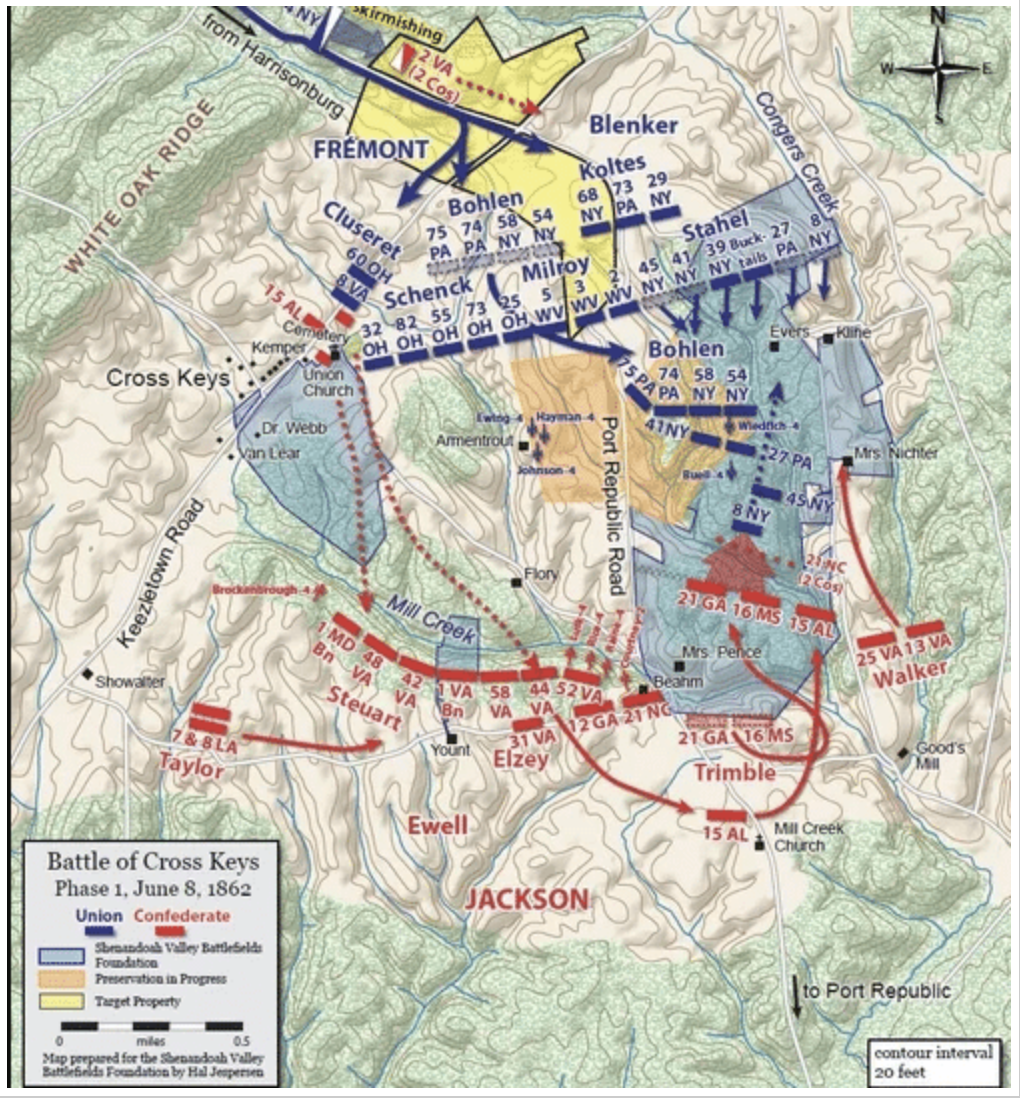
The Shenandoah Valley Battlefield Foundation’s (SVBF) most recent preservation project is at the Cross Keys Battlefield, a part of Stonewall Jackson’s 1862 Valley Campaign.

SVBF’s current preservation project at Cross Keys involves the purchase of this historic Pirkey Farm, over 173-acres of core battlefield where Maj. Gen. John C. Freemont’s 11,500-man Federal army deployed and launched the opening attack of the battle against Maj. Gen. Thomas “Stonewall” Jackson’s 5,800 Confederates under Maj. Gen. Richard Ewell. This purchase includes three of the four corners of the Port Republic and Keezletown Roads and is a prime development target.

The Federals had early success in the battle but were repulsed once it stumbled into a Confederate ambush. Brig. Gen. Isaac Trimble’s brigade pressed the Union left, threatening the Union artillery, and shortly thereafter Fremont withdrew, thus ending the battle with a Confederate victory.

The owner of the land recently passed away and left instructions in their will that the property was to be offered to SVBF for 50% of its value plus $100,000. The project, eligible for the American Battlefield Protection Program (ABPP) grant, means that SVBF can save this important battlefield land for slightly more than $134,000 out of pocket.

To learn more about this project, and all of SVBF’s work, click here.

One Down, One to Go! Data Center VICTORY at Manassas

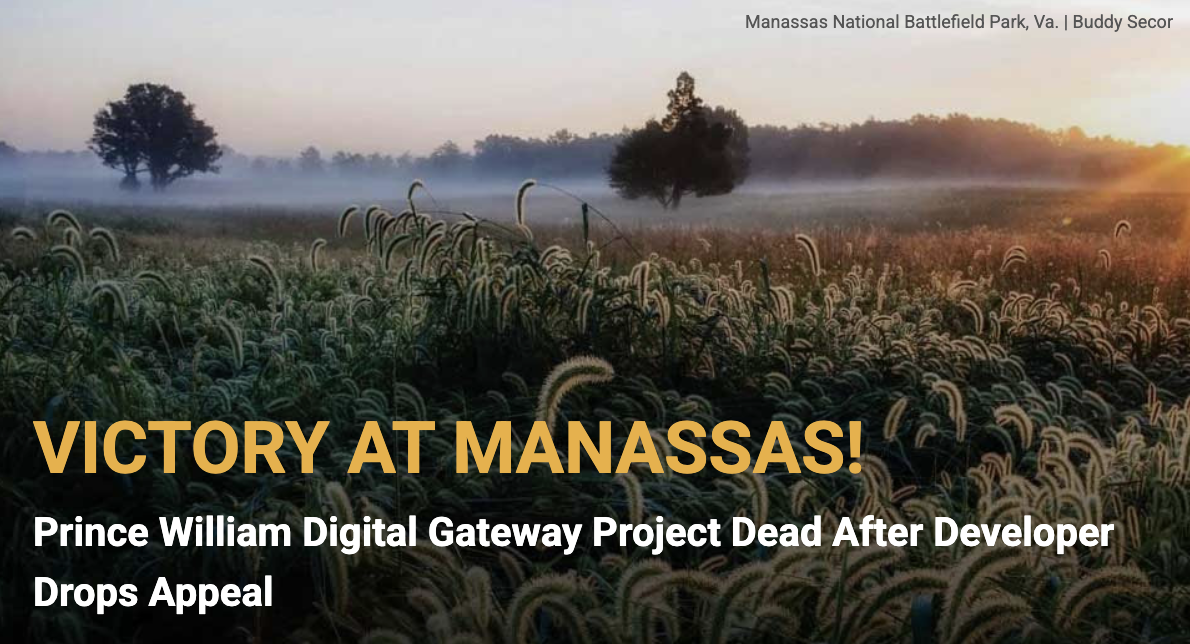
VICTORY AT MANASSAS!

Prince William Digital Gateway Project Dead After Developer Drops Appeal

Read Our News Release

It is quite a month for history!  Just days before America’s 250th birthday, we emerged triumphant in our five-year crusade to prevent a massive data center campus from being built alongside Manassas National Battlefield Park!

Two months after filing an appeal to the Supreme Court of Virginia, developer QTS announced they are ending their defense of the illegal rezoning, following several losses in the courtroom and decisions from both the Prince William County Board of Supervisors and fellow developer Compass to drop out of the lawsuit.

The Trust, the Oak Valley Homeowners Association and local residents filed lawsuits against Prince William County and the two developers, challenging the hasty and improper Board of Supervisors vote that would have made the Prince William Digital Gateway (PWDG) the largest data center complex in the world. On March 31, the Virginia Court of Appeals unanimously ruled in support of a lower court decision voiding the PWDG rezonings, setting up the potential for a Supreme Court case, which, with the support of stalwart members like you, we were prepared to fight.

Thankfully, we can now instead work with Prince William County, the preservation community, local residents and landowners to find a conservation-friendly solution that will protect Manassas National Battlefield Park and other natural and cultural resources along the historic Pageland Lane corridor.

A lot has changed since December 2023, when the 4–3 rezoning vote (with one abstention) was pushed through by a lame-duck Board amid public outcry and against the recommendations from the County’s professional planning staff. Since then, voters have elected supervisors who have expressed concerns about the impropriety of the process and the effect of the project on the County, as well as reluctance to continue spending taxpayer dollars in its defense — a bill that ran north of $1.8 million.  

Communities that once embraced the idea of data centers have reversed course. A recent poll conducted by The Washington Post and George Mason University found that only 33 percent of Virginians would support a data center being built in their community, down from 69 percent.

Today, we celebrate our insistence on thorough and proper consideration of projects with the potential to do irreparable harm to historic battlefields and other cultural resources. Thank you for helping us achieve this important victory!

But, like the great generals who commanded forces on these battlefields, we know that a single victory does not win the war. We must press our advantage, fighting with renewed vigor at the Wilderness, where we are involved in litigation to block another such mega development at the gateway to this irreplaceable battlefield park and historic treasure.

‘Til the battle is won,

David N. Duncan
President
American Battlefield Trust

P.S. With YOUR support, we will remain vigilant and ensure that future proposals that might threaten hallowed ground are held to the same strict standard of scrutiny. Please continue to support the Trust’s advocacy efforts, so that we can be ready for the next danger to come our way.

Support Our Advocacy Efforts

Breaking News: Prince William Digital Gateway Project Developer Drops Appeal

FROM The Emerging Civil War

This afternoon, July 2nd, The American Battlefield Trust (ABT) announced that the Prince William Digital Gateway Project developer, QTS, dropped its appeal in support of the proposed data center development adjacent to Manassas National Battlefield Park.

QTS had appealed to the Virginia Supreme Court; dropping the appeal effectively brings the proposed project to an end.

“This is a banner day for the historic preservation community. Our decision to fight an enormous and inappropriate data center project threatening one of America’s most hallowed historic places has been completely vindicated,” said American Battlefield Trust President David Duncan.

ABT, the Oak Valley Homeowners Association, and local residents had filed a lawsuit against Prince William County, and the two data center developers, Compass and QTS, challenging the rushed and unlawful Board of Supervisors vote to make way for the largest data center complex in the world.

The Prince William Digital Gateway was a proposed 37 data center buildings would have required 14 on-site electrical substations for operations. They would have used over 9 gigawatts of power, enough to power 2 million homes.

Duncan also remarked: “Now that the Prince William Digital Gateway is no more, we look forward to working with the county, the preservation community, and local residents and landowners to find a conservation-friendly solution that will protect Manassas National Battlefield Park and other natural and cultural resources along the historic Pageland Lane corridor.”

To learn more about this and the work that the American Battlefield Trust does, visit their website.

Battlefields Added to Preservation Virginia’s Most Endangered Places List

Emerging Civil War

By Terry Rensel on June 13, 2026

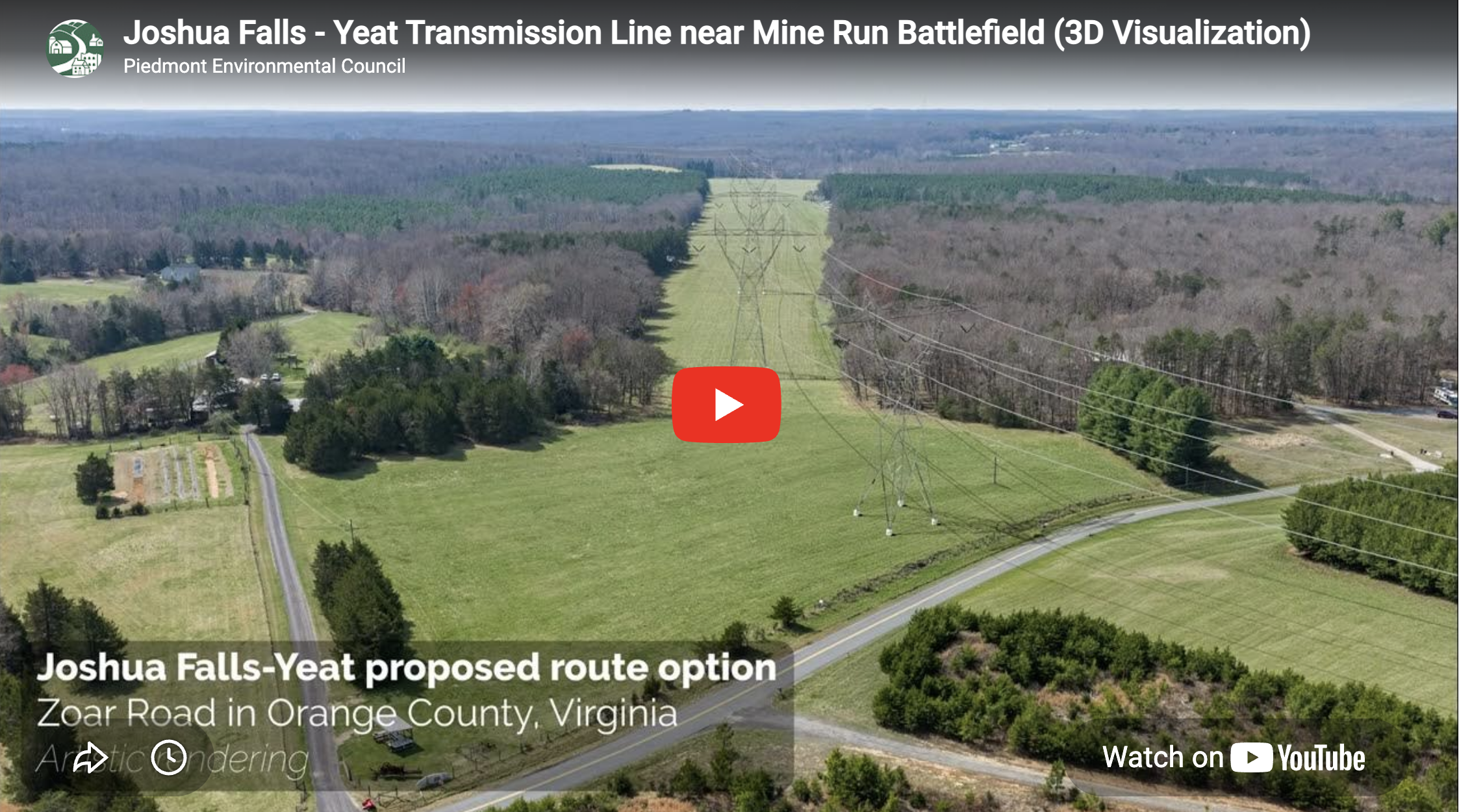
On May 19th Preservation Virginia announced their 2026 Most Endangered Places List. Two Civil War battlefields are on this year’s list due to the Joshua Falls-Yeat Transmission Line Corridor, as part of the Valley Link project.

The Joshua Falls-Yeat Transmission Line Corridor is a proposed 765 Kw transmission line project that would run through nine counties in Virginia. Running 115 miles from near Lynchburg in Campbell County to near Richardsville in Culpeper County, the line would require a 200-foot-wide corridor cutting through Appomattox, Buckingham, Fluvanna, Louisa, and Orange counties, and possibly Goochland and Spotsylvania as well. A future line would be needed from the new Yeat substation in Culpeper County to the Morrisville substation in Fauquier County.

The route would run through the heart of the Yellow Tavern Battlefield Study Area, as well as the Mine Run Battlefield Study Area, and depending on the exact route could also go through part of the Wilderness Battlefield Study Area.

“We all know our world is progressing in ways we would have never imagined. Technology requires data and data needs to be powered. This does not mean providing this power should come at the cost of our nation’s history." Central Virginia Battlefields Trust (CVBT) President Tom Van Winkle said. He continued, “Those who fell on the battlefields affected by this massive transmission line project would have expected those hallowed grounds to be respected. This is not the way to accomplish that expectation.”

CVBT, as well as the American Battlefield Trust, Friends of the Wilderness Battlefield, as well as other historic and conservation groups are joining local citizens in opposition to this project.

To find out more about Preservation Virginia, and their Most Endangered list, visit their website.

To learn more about the threat that the Valley Link project holds, visit the Piedmont Environmental Council website here.

For a YouTube video click here

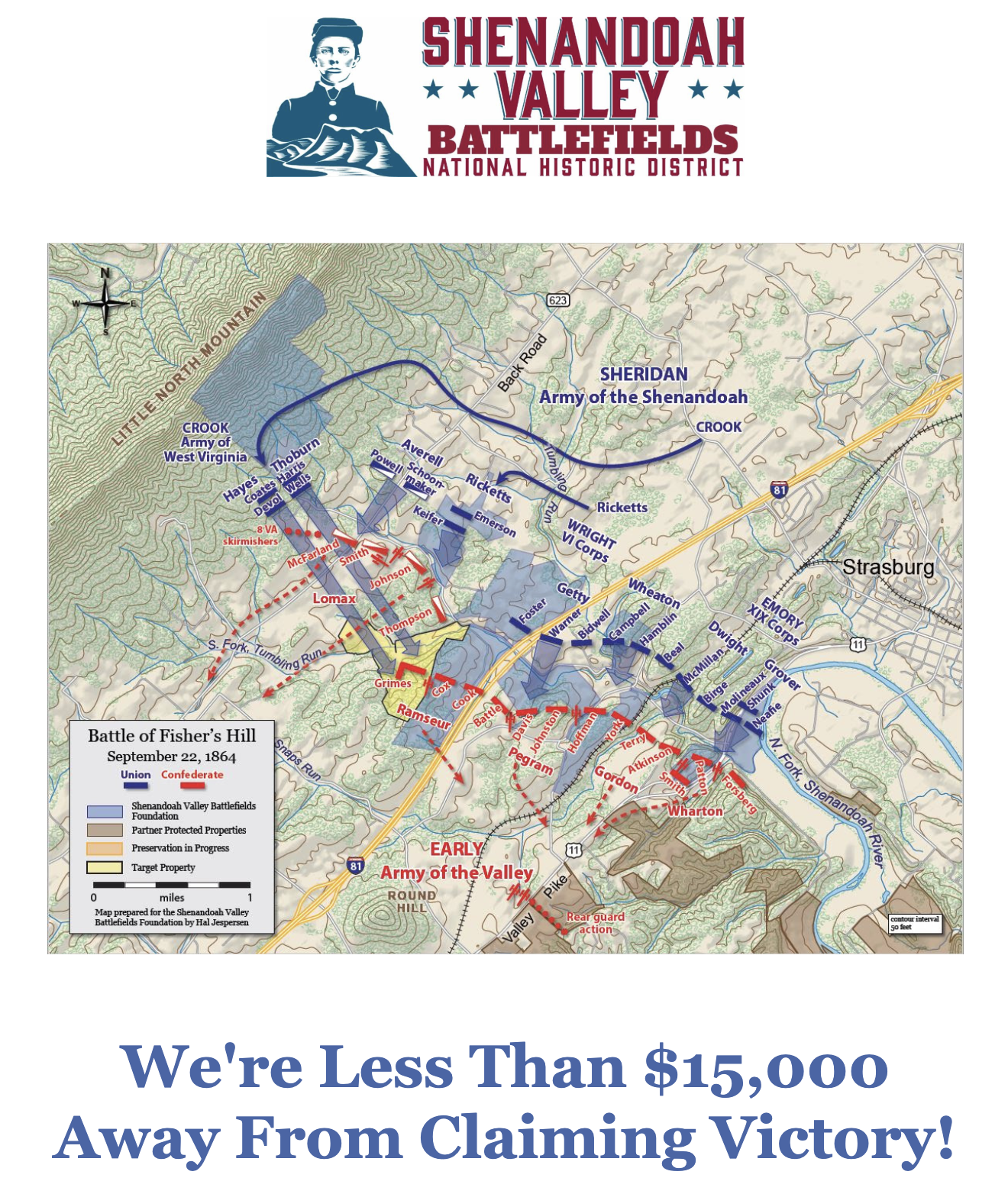
Help Claim Victory at Fisher's Hill Battlefield

 Over the last few weeks, many of our friends from across the country have joined the final push to preserve the 146-acre Funkhouser Farm at Fisher's Hill - raising over $74,000! No other place on the Fisher's Hill Battlefield saw more fighting and now we are locked in the last moments of our fight for the same ground. 

We have a little less than $15,000 left to go if we are going to reach our $89,000 goal. If we can pull together these final funds, we can pay off this project and preserve the Funkhouser Farm forever. We are making deals to preserve battlefield tracts from one end of the Valley to the other and our next project announcement will be hitting your mailboxes in the coming weeks. Let’s not leave anything to chance, hoping someone else will cover the final cost. 

Donate to Save the Funkhouser Farm

. If you’ve already made your contribution, thank you for bringing us this far! If you are still looking for a way to do your part to save critical battlefield land – here’s your opportunity! Please, don’t delay. Make your gift today and make this property a lasting testament to how much you cared about our history and the men who fought and died for our nation . . .

See you at the Front,

Keven Walker

Chief Executive Officer

Help Us Save Three Historic Acres on Part of the May 1, 1863, Chancellorsville Battlefield!

Dear Preservation Partner,


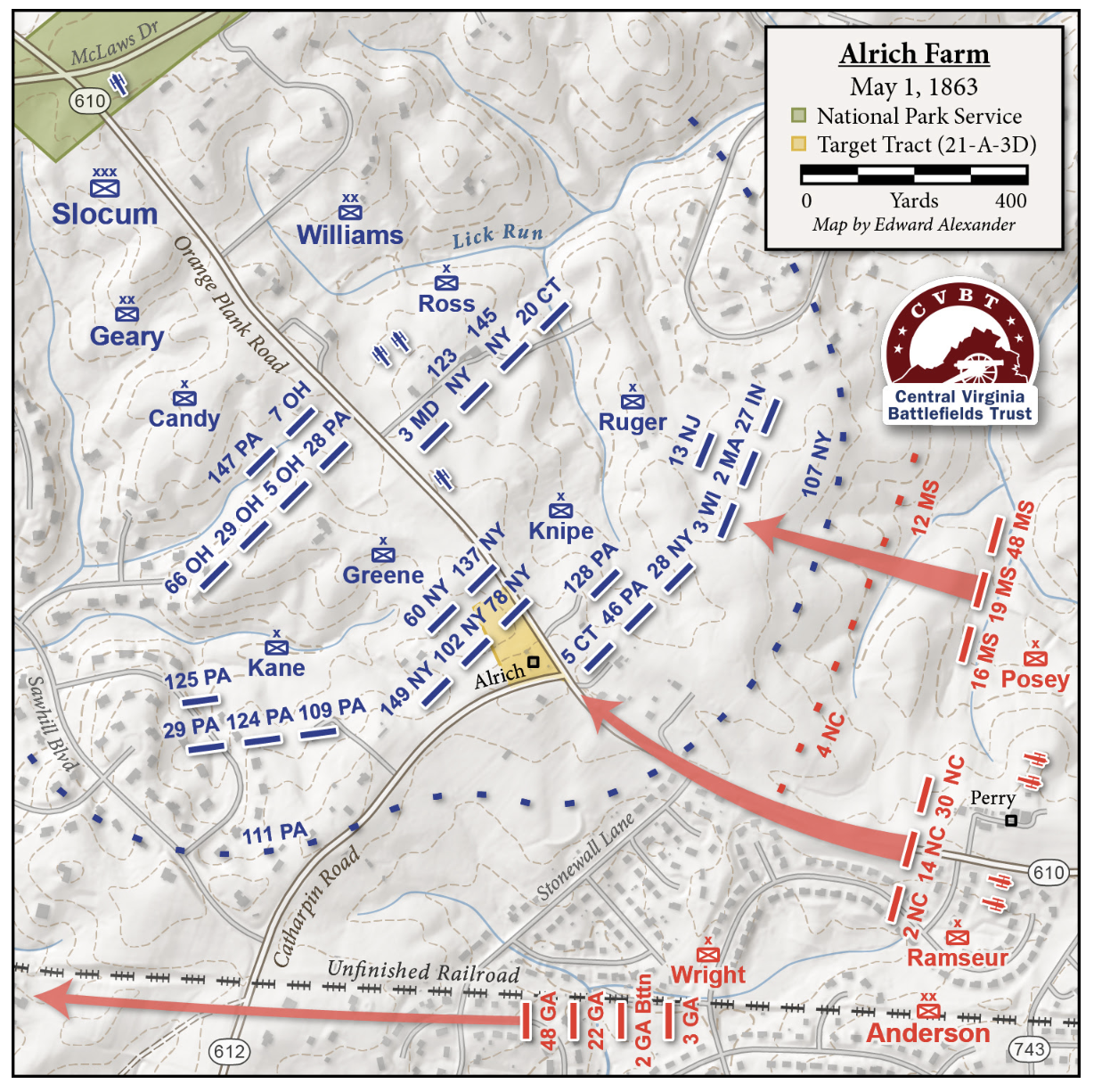
When it comes to discussing the Battle of Chancellorsville’s three primary days of fighting, May 1, 1863, often gets the least attention due to the high drama actions of May 2 and 3. However, it is important to remember that what happened on May 1 set the scene for what played out the following two days. Through the generosity of our donors, the Central Virginia Battlefield Trust (CVBT) played a key part in helping save the First Day Chancellorsville portion of battlefield that was fought along the Orange Turnpike (present day Route 3). Even less awareness falls to the May 1 fighting that happened just to the southwest, near the Orange Plank Road (modern Old Plank Road) and Catharpin Road intersection. Until the fall of 2025, nothing had been preserved at the historic crossroad. Thanks to you, our supporters, that is changing!


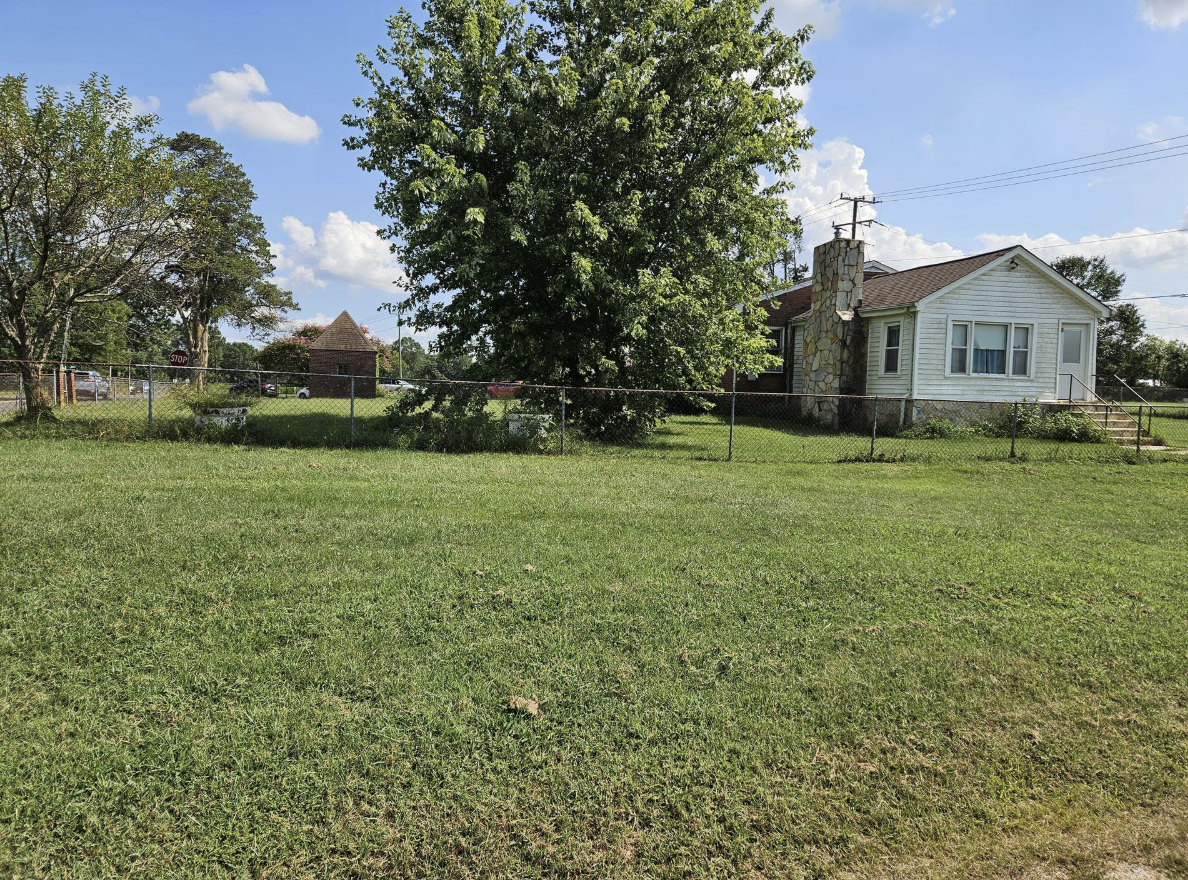
The CVBT is currently fundraising $100,000 to save the initial parcel of what was the historic Alrich Farm. This first three-acre tract—the site of the Alrich House—is better known as where the 23rd United States Colored Infantry fought off Confederate cavalry under Gen. Thomas Rosser on May 15, 1864. That engagement signaled the first time USCTs fought against the Army of Northern Virginia north of the James River. However, the year before, this location witnessed the Army of the Potomac’s XII Corps battling elements of Gen. Richard H. Anderson’s Confederate Division.


At midday on May 1, 1863, after pushing forward to the Alrich house and engaging with Confederate artillery and infantry, XII Corps commander Gen. Henry Slocum received orders from army commander Gen. Joseph Hooker to fall back toward the Chancellor House. Slocum was incensed at the idea of withdrawing but followed orders. While this May 1 engagement was relatively small compared to what would come the following two days at Chancellorsville, the families of those soldiers who were killed would always remember it. Of course, those who received wounds there were also significantly affected.


Among the wounded on May 1 at the Alrich Farm was Corp. John C. Ellis of the 111th Pennsylvania Infantry. In a letter to his nephew three weeks later, Corp. Ellis explained, “the order was given to fall back to Chancellorsville on double quick and our Regt was to cover the retreat of the balance of [Gen. Thomas Kane’s] brigade[.]  [T]he other Regt[s] were so slow in moving[,] the Rebs [were] upon us before we knew it[,] so that by the time that we got to the Plank Rd the Reb Sharpshooters began to pick off our men[.] the Bullets flew like hail arond our heads[.]” One of the bullets found Ellis. “[T]he first thing I knew I was laying on my back in the ditch along side the Road,” he wrote. “[I was] struck by a bullet on the left side of the back of my neck coming out at the corner of my left eye making a verry dangerous wound[.] [W]hen I fell I was completely Paralized and Blind although I never lost my senses for a single moment[.] Ellis was believed dead, “and the Rebs were right at [our] heels so that if [my comrades] wanted to they could not have [stopped and] picked me up.”

 Donate Today

One of Ellis’s fellow 111th Pennsylvania comrades, Pvt. James T. Miller, wrote home that “the reble sharpshooters opened on our column and kiled some two or three of our regt. . . .” More, like Ellis, were wounded. Corp. Ellis remained on the battlefield until captured by the advancing Confederates. Taken to a farmhouse, perhaps the Alrich House, he received treatment for four days until he was sent to a crowded Federal field hospital, where he was exposed to the elements for an additional three days. “[H]ow in the world I survived through it is more than I can tell[.] It was 15 days from the time I was shot untill I rejoined the Regiment again,” he explained. Ellis, who was significantly older than most of his comrades, eventually received proper treatment and transferred to the Veteran Reserve Corps. He died at 60 years old in 1882.

In addition to the purchase of these initial three acres, there is significant work to be done to return the tract’s landscape, as much as possible, to its wartime appearance. A mid-twentieth century house sits approximately where the Alrich House once stood. It, along with a modern shed and a chain link fence that currently surrounds the house, will need to be removed to satisfy the conditions of the anticipated grant funding and to give future visitors to the site a true sense of its period look. This expense, which is of course outside and in addition to the purchase price of the property, is a significant cost in itself.


Due to so much rapid development in Spotsylvania County over the last forty years or so, it is a rare occurrence when a battlefield property becomes available that does not have a modern structure on it. However, CVBT has an excellent track record with landscape restoration projects. We removed “The Castle” eyesore that stood along modern Route 3 at our Rodes-Doles tract in 2013, as well as the nearby modern house at the Beckham tract in 2025. Additionally, in 2020, the house at the Spotsylvania 5th Corps Brock Road parcel came down. These properties now have a helpful period atmosphere to them.

A secondary yet still significant benefit to demolishing modern structures on battlefield properties is that doing so adds to our area’s ever-shrinking green space acreage. Battlefield earth, grass, trees, and streams are important to our environment in an ever-expanding world of residences, steel and glass buildings, and concrete, asphalt, and paved surfaces. Battlefields also provide natural resources that help prevent erosion, give oxygen to our atmosphere, supply plants for vital pollinators, and allow flora and fauna to thrive in their natural ecosystems. Being in these environments helps us as human beings as well, both physically and mentally.


Although generous gifts are arriving in all sizes and from all across the United States, we have only raised one-third of the $100,000 goal we set last fall for this property. As previously mentioned, this is the initial parcel of what will hopefully preserve thirty acres of twice fought over battlefield land. Many of you have given toward this project previously, some have generously made multiple donations. We sincerely thank you for the past gifts and hope you will consider giving yet again to help us reach our goal. Let’s save and share the history of what happened there!


Sincerely, 

Tom Van Winkle, CVBT President

 Watch this video to Learn More...


Visit our website to learn more about this preservation project, the history connected to the land, and to view a detailed map!

Donate Today

Central Virginia Battlefields Trust has been saving hallowed ground at Fredericksburg, Chancellorsville, Mine Run, and the Overland Campaign, including the battles of The Wilderness, and Spotsylvania Court House for almost 30 years. Visit www.cvbt.org to learn more.


Please note: Central Virginia Battlefields Trust will make every effort to see that funds raised from this appeal will go to the battlefields named. In the event that funds are raised in excess of the amount required, your donation will be put to where the need is greatest.

Central Virginia Battlefields Trust Inc
PO Box 3417
Fredericksburg, VA 22402

Preservation Effort in the 11th hour at Stones River & Fort Heiman

An extraordinary but time-sensitive preservation opportunity is at hand, and your support is needed to secure it.

  Two tracts at Stones River, TN, and one tract at Fort Heiman, KY,
have been at risk of development for years.

  In the past, federal preservation assessments deemed these tracts unworthy of protection in their current state, yet deeply significant to military history. But thanks to the efforts of generous partners in preservation, tremendous progress has already been made at Stones River.

An astonishing $57-to-$1 match!

The moments that unfolded at these battlefields were critical to the outcome of the Civil War. Every $100 donation today will turn into $5,700 of impact preserving this hallowed ground.

MATCH MY GIFT

These 140 hallowed acres over three tracts in Tennessee and Kentucky tell the story of two pivotal Civil War moments.

  • The Battle of Stones River ranks among the most important battles of the entire Civil War, and the 7th bloodiest — sitting between Antietam and Shiloh.

  • Fort Heiman’s bloodless capture by Grant helped fracture the Confederacy’s entire West defensive line, triggering retreats from Kentucky and setting in motion the chain of events leading to Shiloh.

The larger of the tracts at Stones River is comprised of 122 acres of hallowed ground. This large, pristine tract is a rarity at Stones River, which is situated in Murfreesboro, TN, one of the fastest-growing communities in the nation.

  In recent years, the owner has been flooded with offers from developers seeking to buy it for residential, commercial, and mixed-use development. The value of this land has increased almost daily, and given this hot real estate environment. I can’t think of a more threatened situation.

  Your support today — matched 57x — ensures these historic 140 acres at Stones River and Fort Heiman are preserved.

 Please help us honor and protect this land for good.

 'Til the battle is won,

David N. Duncan, President
American Battlefield Trust

P.S. These tracts valued at $21 million — ready for us to obtain at just $377,205 (a 57x match) thanks to state and federal funds along with the generosity of our partners — won't be available for long. Please help secure this land at Stones River and Fort Heiman to ensure its permanent preservation.

ABT Taking the Data Center Fight to the Supreme Court of Virginia

The deep-pocketed developers behind the Prince William Digital Gateway, the massive data center complex at the edge of Manassas National Battlefield Park, just don’t know when to stop.

First, a three-judge panel in the Virginia Court of Appeals upheld the lower court’s ruling that the hasty rezoning vote was illegal. Then, the Board of Supervisors unanimously voted to withdraw the county’s support for any further appeals in the case, stopping the use of nearly $2 million in taxpayer money. Then Compass, one of the two firms behind the original proposal, announced that it would not exercise its right to appeal to the state’s highest court.

We’d hoped that QTS, the remaining developer, would see the wisdom in also standing down. We were cautiously optimistic that our five-year fight against this monstrosity of a proposal — 37 data center buildings requiring 14 on-site electrical substations and consuming enough energy to power more than 2 million homes — would be at its end.

We were wrong.

At the conclusion of the 30-day window for filings, we learned that QTS is filing a petition of appeal on the matter to the Supreme Court of Virginia.

And so, the fight continues — thanks tosupporters like you.

When I wrote to the Trust’s membership last month about the status of our two lawsuits against data center developers and the counties who approved their plans through flawed and illegal processes, I said that we “have them on the run.” They are getting desperate and are down to their last lines of defense – but they still have vast resources at their disposal to keep up the fight.

And so, our long campaign continues. We cannot surrender now, when the stakes have never been higher.

Help Keep the Fight Alive — Make a Gift Today!

Please consider making a gift to support the Trust’s advocacy efforts, to keep us in the fight as we prepare to stand before Virginia's highest court. Doing so helps ensure that we have the resources to continue the highest level of opposition we can muster – without sacrificing our ability to protect a single acre of the hallowed ground we are currently in negotiations to secure.

This isn’t the outcome we hoped for, but we will continue the fight.

‘Til the Battle Is Won – on the field or in the courts,

David N. Duncan
President
American Battlefield Trust

438 acres. Seven battlefields. One urgent opportunity.

The Civil War was not fought in isolation. What happened in one place shaped what came next somewhere else. Victories opened doors. Defeats forced new strategies. Movements in one theater influenced outcomes in another.

  Today, you have a rare opportunity to help preserve pieces of that larger story.

  Right now, we are working to protect 438 acres across seven historic battlefields:

  • Richmond & Perryville, Kentucky

  • Glorieta Pass, New Mexico

  • Corinth, Mississippi

  • Hoover's Gap, Tennessee

  • Resaca, Georgia

  • Newtonia, Missouri

  These places may be miles apart, but they are tied together by consequence. Each played a role in shaping the course of the war — and the nation that followed. 

What your gift can do right now to preserve historic grounds:

  • Protect 438 acres across seven historic battlefields

  • Unlock a 10-to-1 match — multiplying your impact

  • Help secure land valued at nearly $3.9 million

  • Preserve key ground at Resaca, Hoover's Gap, Corinth, and more!

DONATE NOW

These tracts of historic land are at risk.

Without action, they could be lost to development — warehouses, subdivisions, and commercial projects that would permanently alter these historic landscapes and diminish our ability to fully understand what happened there.


The good news is: we are incredibly close to saving them.

  Thanks to strong partnerships and matching commitments, more than 90% of the funding is already secured. Now, we must raise just $374,900 to protect land valued at nearly $3.9 million.


Every $1 you give today will be multiplied in impact more than 10-to-1. Opportunities like this are rare — and they don't last long.

  At Resaca, hundreds of acres once stood on the brink of industrial development. At Hoover's Gap, Newtonia, and Glorieta Pass, land was on the market for sale to any interested developer. At places like Corinth and Richmond, even small tracts help complete a much larger historical picture.


Each acre is a piece of the story. This is now your chance to help protect that story in its fullest form.

Please make your gift today to help save these 438 acres.

 Thank you for standing with us in this important work.

 'Til the battle is won,

David N. Duncan

President

American Battlefield Trust

P.S. The battles at places like Resaca, Perryville, and Glorieta Pass were not isolated events — each helped shape what followed next. Protecting these acres helps preserve that chain of history, where one decision, one movement, changed everything.

DONATE NOW

Help Preserve At Risk Land at Gettysburg and Antietam

Right now, the Trust has a rare opportunity to protect three unprotected pieces of Civil War battlefield land — two at Antietam and one at Gettysburg — before they are lost to development. 

To save them, we must raise $349,938. Thanks to support from incredible donors, we are nearly 80% of the way to reaching our previous goal at Antietam, and to saving an additional remarkable property at Gettysburg for future generations.

With just a few weeks left to meet the total needed to save these Antietam tracts, we've been presented with another incredible opportunity: preservation of a small, but significant property at Gettysburg — only about 40 miles away!

Thanks to generous partners and federal grants, every dollar you give today is matched, nearly quadrupling your impact.

Hallowed Grounds at Antietam & Gettysburg are at risk!

Your support today helps ensure Antietam and Gettysburg remain places of reflection, learning, and honor.

Protect Three Tracts at Antietam & Gettysburg

What's currently at stake:

  • At Antietam, these fields witnessed the desperate Final Attack on September 17, 1862 — the costliest day in American history — when Union forces surged forward and the fate of the war hung in the balance. Just days later, the Preliminary Emancipation Proclamation reshaped the nation's future. Preserving this land protects the place where freedom took a decisive step forward.

  • At Gettysburg, a single unprotected acre near the Baltimore Pike tells another critical story. Thousands of Union soldiers crossed this ground under fire as they rushed to defend Culp's Hill during three pivotal days of fighting. Today, that land remains vulnerable to development that would erase its connection to the past forever.

Time is not on our side. But with your help today, we can secure these sacred acres for future generations.

Please act now and help defend history at Antietam and Gettysburg.

Donate Now

'Til the battle is won,


David N. Duncan
President
American Battlefield Trust

P.S. Once historic land is lost, it cannot be reclaimed. Your support today helps secure these sacred places at Antietam & Gettysburg while we still can. Can we count on you to make a gift today?

Help Reauthorize the American Battlefield Protection Program

As a supporter of the American Battlefield Trust, you've almost certainly heard of the outstanding federal matching grant program that enables us and other battlefield partners to leverage our members' donations and purchase important historic properties. Over the past 25 years, the U.S. Congress has appropriated more than $250 million for the American Battlefield Protection Program (ABPP) and the Battlefield Land Acquisition Grant Program (BLAG), which has been multiplied many times over by private donations and state and local monies, leading to the protection of more than 36,000 acres of battlefield land throughout the nation.

Today, the Trust is asking for your help to ensure that this remarkable vehicle for historic land conservation continues into the future.

Learn More & Sign the Support Now!

Recently, U.S. Senators Dave McCormick (R-PA) and Tim Kaine (D-VA) introduced legislation to reauthorize the BLAG program through 2035 and make minor refinements to BLAG’s sister programs: the Battlefield Interpretation Grant Program and the Battlefield Restoration Grant Program. The Trust is asking supporters like you to reach out to their Senators and Members of Congress, via a simple mechanism on our website and urge them to become cosponsors of this important and bipartisan legislation.

The ABPP Reauthorization Bill maintains funding for the program at $20 million per year. In addition, it decreases the private match requirement on interpretation and restoration grants to 25 percent, a reduced fundraising burden that will enable a wider variety of local battlefield organizations to apply. It also directs the National Park Service to study the feasibility of expanding eligibility for BLAG grants to sites from the French and Indian War and the Mexican-American War. Engagements of those conflicts on U.S. soil have already been mapped under the auspices of ABPP, establishing the historic boundaries that are a key prerequisite for evaluating all land acquisition projects.

In all of our past reauthorization pushes, the BLAG program has enjoyed deep bipartisan support in both houses of Congress, and we expect a similar scenario for this forward-looking program that marries historical literacy with land conservation goals. Our champions on Capitol Hill are excited to support the bill, but a wider array of lawmakers are likely to join us – if they hear from constituents like you, who care deeply about the issue.

Show Your Support – Sign the Letter Now!

Taking a few moments to use the simple form on our website will enable you to send a message to your Senators and Member of Congress, registering your support for battlefield preservation and the track record of the BLAG program over the years.

Please lend your voice to our outreach work – and share the link with your friends and relatives who share our passion for the power of place and believe that these hallowed landscapes should be protected.

 Sincerely,

Jim Campi

Director of Policy and Communications 
American Battlefield Trust

141 Acres to Preserve in NC, TN & MO

Across the country, the ground where history was made is disappearing at alarming rates. Quietly. Permanently. And often before anyone realizes what has been lost. 


Today, 141 acres of hallowed Civil War land at Wilson’s Creek, Shiloh, and Bentonville are at risk of being swallowed by development. These are not symbolic places — they are real landscapes where the course of the war turned, where commanders fell, and where soldiers fought and died. 


If this land is lost, it could be lost forever. 


We have a rare and powerful opportunity to protect 141 acres — land spanning three different years of the war and three pivotal moments in the Western Theater. Together, these sites tell a story of chaos, courage, sacrifice, and change that cannot be fully understood from books alone. 


What makes this moment extraordinary is how close we are to success: the total value of the land exceeds $3.2 million, but thanks to state and federal grants and committed preservation partners, only $170,500 remains to be raised. Even more remarkable: every dollar you give is matched $19 to $1, multiplying your impact far beyond a single gift.


That means a contribution today doesn’t just help — it moves the needle. It turns urgency into action and ensures we can act before developers do. 

This Western Theater land includes:

  • Ground at Wilson’s Creek, where Union General Nathaniel Lyon became the first Union general killed in battle.

  • Land at Shiloh, where the sudden death of Confederate General Albert Sidney Johnston changed the course of a fierce fight.

  • A critical area at Bentonville, where the Confederacy made its final major stand in the Western Theater just weeks before the war ended.

MATCH MY GIFT $19-TO-$1

Our battle today is not against armies, but against time and development pressure. With your help, we can ensure these fields remain places of learning, remembrance, and honor — not developed. 


Please consider making a gift today. With the match in place and the finish line so close, your support can help secure every remaining acre. 

MULTIPLY YOUR IMPACT »

'Til the battle is won, 

David N. Duncan, President

American Battlefield Trust

P.S. Once land like this is lost to developers, it can be nearly impossible to reclaim. But if we act now, we can protect these acres and ensure these stories remain teachable.

DONATE NOW

Save 127 Acres at Three Battlefields

Save 127 Acres at Kernstown

Friends,

If we act now, we can save 127 acres of core battlefield that saw heavy action in not one, not two, but THREE battles in three of the most pivotal campaigns of the war!

The property is situated along Sandy Ridge west of the Valley Turnpike and the famed Pritchard Farm. Historically the property was a part of the Rose Hill Farm and for generations has been part of the Glass family estate. Julian Glass gave the property to the Glass Glen Burnie Foundation, who, after many years, decided to put the property up for sale. Located between land that Glass Glen Burnie previously opened as a community park, and land preserved by the American Battlefield Trust and now owned by the Kernstown Battlefield Association, developing this property would have been a disaster. The neighborhood of single-family homes planned for the 127 acres would have permanently divided the previously preserved tracts, severed interpretive access and destroyed forever some of the most fought-over ground in the Shenandoah Valley.

Donate to Save 127 Acres at Kernstown

These parcels were the scene of significant fighting in three separate battles, but they are also extremely expensive with the final purchase price coming in at more than $2.7 million.

Even with the seller agreeing to finance part of the purchase and the extremely fair lending terms being offered by our partners at First Bank, the loans would do us no good if we couldn’t make the payments. Those payments include the interest – significant interest - more than $15,000 a month. Interest is not refundable through state or federal battlefield grants and is a significant burden on the overall project and the cash flow of the Foundation. That’s when the Ridgeway and the Wilkins families stepped in to help. Realizing that the cost of the financing would make the project impossible for us to tackle, they offered to provide the funding needed to cover the interest payments; buying us the time we need to pull together the funding that will preserve the property forever.

So, with their unbelievably generous support and a $25,000 down payment provided by the Kernstown Battlefield Association we signed the agreement and have already secured a $1.7 million grant from the Commonwealth of Virginia to put toward the purchase. That grant was the largest single grant ever awarded in the history of Virginia’s Battlefield Preservation Fund!

We still need to raise with $55,363 to complete this project and we already have a lead gift to get the ball rolling! Compadre, the beloved canine companion of our longtime friend and supporter Amy Kennedy, unfortunately passed away recently. He was a battlefield lover and had attended many of our conferences through the years. In April, Amy gifted us Compadre’s “estate”, making a legacy gift in his name for $6,000! Compadre loved walking the Kernstown Battlefield, so the decision was made to make his gift the first to be put toward the purchase of these 127 acres. He’s our first canine donor and the first to make a gift to this project!

With Compadre’s gift we are left with just $49,363 to raise! We’re asking you to join the Ridgeways and the Wilkins – we’re asking you to join Compadre and us – please join the fight to save 127 acres of core battlefield at Kernstown.

See you at the Front,

Keven Walker

Chief Executive Officer

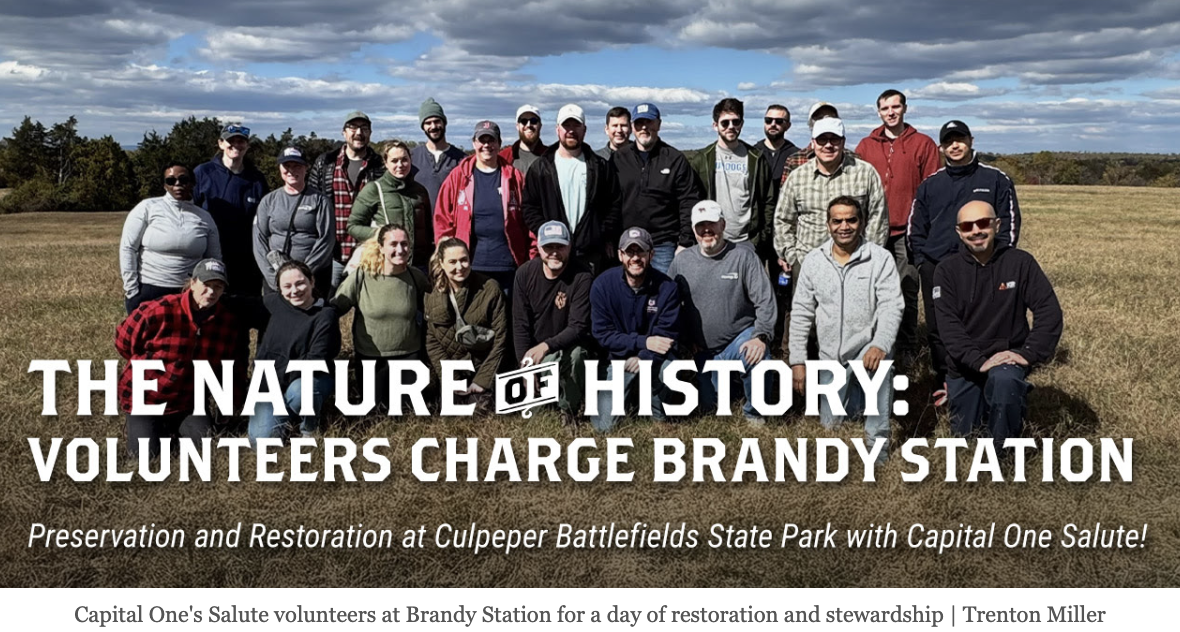
The Nature of History: Volunteers Charge Brandy Station

For the fourth straight year, the American Battlefield Trust partnered with Capital One’s Salute Business Resource Group for a day of partnership and preservation. Around 50 volunteers joined Trust staff to help manage invasive weeds and overgrown vegetation encroaching on the historic Wiltshire House and stone wall on the Brandy Station Battlefield. 

"The collaborative spirit of Capital One’s dedicated volunteers, working shoulder-to-shoulder with organizations like the American Battlefield Trust, is an effective way to ensure the memory and integrity of these hallowed grounds endures for generations," said Daniel Canchola, a volunteer with Capital One.

Invasive species can suppress native plants and take over the composition of an ecosystem. Volunteers received training and supervision in several safe and effective methods for controlling invasives, including multiflora rose, autumn olive and Japanese honeysuckle, helping to keep the battlefield's ecosystem thriving. This includes teaching volunteers what herbicides are safe for the environment, allowing people to put their training into practice and be stewards of the environment beyond the volunteer event.

Part of Culpeper Battlefields State Park, the Brandy Station Battlefield is best known as the site of the largest cavalry clash ever fought in the Western Hemisphere. Decades of diligent effort by the American Battlefield Trust, the Brandy Station Foundation, the Commonwealth of Virginia and preservation advocates have saved more than 2,100 acres from development.  The work done by the Capital One volunteers helps keep the site a testament to the power of place offered by a battlefield.

“For all the great conversations and fun we had, we also got a tremendous amount of work done,” added Saielli. “Walking the property afterwards, I could not believe how much this group was able to accomplish.”

Capital One’s Salute group supports military associates as they continue their life of service outside of the military, providing community resources, volunteer opportunities and intersectional programming. Events in previous years have taken place on battlefields like Fredericksburg and Hatcher’s Run, and plans are already in the works for another volunteer event in 2026.

"It is a true privilege to work for a company that values giving back. I am honored to contribute to the preservation of our battlefields, ensuring that future generations can continue to learn about our history,” said Megan Wible, a Capital One volunteer.

The annual volunteer event with Capital One is just one example of the Trust’s Warrior Legacy program, which showcases the deep connections that today’s veterans and active-duty military retain to their historic forebearers. Through the initiative, the Trust has shared the stories of recipients of our nation’s highest military honor with the Medal of Honor Valor Trail, supported deeply impactful veterans’ archaeological work in partnership with American Veterans Archaeological Recovery (AVAR) and organized several volunteer events with veterans' groups, including for the Trust’s annual Park Day volunteer effort.

Preserve The Missing Piece at Appomattox Court House

Every so often, a preservation opportunity appears that is simply too important to ignore: the kind that allows us not only to protect the past, but to complete the story future generations will inherit.


Two profoundly significant pieces of battlefield land in Virginia, together just 2.4 acres, are urgently in need of saving. Though small in size, they represent pivotal moments in the course of our nation's history.


The first tract of land at Appomattox Court House is the one of the last at-risk pieces within the preserved landscape. This is the land that witnessed Lee's surrender on April 9, 1865, signaling the start of national reconciliation. Securing it would nearly complete decades of our preservation work and ensure that future generations can fully understand the story that began there.


The second parcel stands at the intersection of the Gaines' Mill and Cold Harbor battles. Troops marched, fought, and fell across this very ground. Cavalry charged through its intersection. Today, it remains vulnerable to commercial development, despite its immense historical significance.


Together, these lands are valued at $680,000. Yet, through a combination of state and federal grants and a deferred payment agreement, only $172,500 must be raised by the end of January. And during this time, every gift is multiplied $4-to-$1.


Each dollar you contribute protects four dollars' worth of historic land.

A missing corner at the crossroads that witnessed both Gaines' Mill and Cold Harbor. 

With your help, we can secure this tract and another at Appomattox before they're lost.

MATCH MY GIFT $4-TO-$1

Your support today will help complete the preserved landscape at Appomattox Court House, safeguard the crossroads at Cold Harbor from development, and protect ground walked by Grant, Lee, Custer, McClellan, Jackson, Stuart, and the thousands of soldiers whose footsteps left a permanent mark on our nation's history.


These acres may be small, but the stories they hold are immense. Your support while this opportunity still stands will ensure they are passed down for generations ahead.

DONATE NOW TO MULTIPLY YOUR IMPACT »

With gratitude, 

David N. Duncan

President

American Battlefield Trust

We Did It! Gaines Mill-Cold Harbor Saved Forever!

I write to you with incredibly exciting news, decades in the making: 

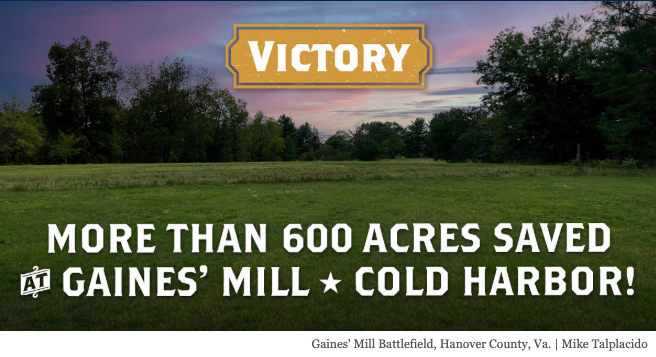
Some of the most important unprotected battlefield land in the United States, hundreds of critical acres at the site of both the Battle of Gaines’ Mill and the Battle of Cold Harbor, is saved forever.

One of the largest preservation efforts in our history, these 600+ acres more than double the amount of hallowed ground we have protected on these irreplaceable battlefields. 

In 1862, this land witnessed Confederate Gen. Robert E. Lee launch one of the largest frontal assaults in the Civil War. In 1864, it saw Union Gen. Ulysses S. Grant order one of the war’s bloodiest attacks. Across two battles, thousands of men made the ultimate sacrifice on these battlefields. This land is hallowed ground, and it is now forever protected because of you.

More than 25 years ago, the American Battlefield Trust set out to save the overlapping battlefields of Gaines’ Mill and Cold Harbor in Virginia. By 2020, 655 acres had already been preserved when a once-in-a-lifetime opportunity emerged: more than 600 additional acres of pristine battlefield land became available. With deep-pocketed developers closing in, swift action was essential.

Our friend and renowned historian Ed Bearss once said: “Even if you have to sell every other piece of battlefield land the Trust has ever saved in order to preserve this land, you should do it. It’s that important!” Thanks to your support, this land is now a part of the more than 1,200 acres saved at Gaines’ Mill and Cold Ha rbor, 30,000 acres saved throughout the Commonwealth of Virginia, and 60,000 acres we have saved nationwide.

Now, generations to come will understand these two battles and appreciate history in a way only a battlefield can offer.

★ ★ ★

“If pressed to select the single most desirable [land] on any battlefield... Nowhere else does a single [area] of land offer so much relating to a pair of major battles.” – Historian Gary Gallagher

★ ★ ★

The Battle of Gaines’ Mill 

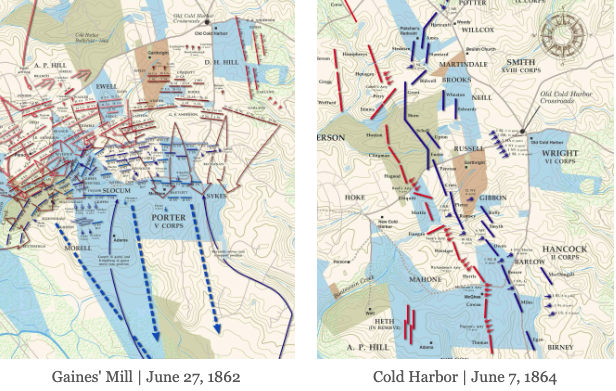
On June 27, 1862, just east of Richmond, Virginia, Union Gen. Fitz John Porter’s V Corps found itself alone and outnumbered. With their backs to the Chickahominy River, Porter’s 34,000 men dug in near a modest structure known as Gaines’ Mill. Facing them was a determined Confederate force of nearly 60,000 under the newly appointed Gen. Robert E. Lee. This clash would become the largest Confederate frontal assault of the Civil War and mark Lee’s first major victory as commander of the Army of Northern Virginia.

Despite being outnumbered, Porter’s troops held firm against repeated assaults throughout the day. But the arrival of Gen. Thomas “Stonewall” Jackson’s troops allowed Lee to launch a massive, coordinated twilight attack that ultimately overran the Union position. The cost was staggering: 15,000 casualties in just six hours. The bravery of those men – fighting in marshes, woods, and over open farmland – still echoes across the land today. 

The Battle of Cold Harbor

Fast forward to June 1, 1864. Nearly two years after Gaines’ Mill, Union Gen. Ulysses S. Grant ordered his forces to engage once more on these blood-soaked fields during the Overland Campaign. The Battle of Cold Harbor, taking place just 10 miles northeast of Richmond and overlapping portions of the 1862 battleground, was characterized by entrenched lines, devastating frontal assaults and some of the highest casualty rates of the war.

Grant’s repeated attempts to break the Confederate defenses culminated in a massive but futile attack on June 3. Union forces suffered thousands of casualties in under an hour. It was a sobering moment for Grant and a grim reminder of the cost of war. Still, he did not retreat. Instead, he repositioned his army and crossed the James River, advancing toward Petersburg in what would become the beginning of the end for the Confederacy.

  As 2025 draws to a close and we enter the holiday season, I reflect on all that this year has meant to the American Battlefield Trust. Together, we began the 250th celebration of the American Revolution, took our digital education offerings to new heights, supported thousands of students on field trips, scored major victories in the courts to keep battlefields free of development, celebrated the milestone of our 60,000th acre saved, and now, the culmination of one of the most ambitious preservation campaigns in the nearly 40-year history of our organization.  

None of this would be possible without you. If not for your support, we could not save one acre of hallowed ground. Our work is far from over at Gaines’ Mill, Cold Harbor, and other battlefields across the country, but I could not be more proud or thankful for all we have accomplished together.  v

‘Til the battle is won,

David N. Duncan
President
American Battlefield Trust